A look back at the MOT General Assembly: spatial planning at the heart of the discussions

Field visits
Hosted by the Eurodistrict Trinational de Bâle and the Collectivité européenne d’Alsace, more than 110 participants were able to discover several projects illustrating the reality of the cross-border catchment area: the Parc des Carrières, an example of the regeneration of an area shared by France, Germany and Switzerland; the Palmrain area and the Infobest network, which provides day-to-day support for residents and cross-border workers. The second day was devoted to a tour of the 3Land project: a large-scale cross-border development project covering nearly 600 hectares, situated at the junction of three borders, incorporating industrial, port and residential areas, economic activities, public spaces and new forms of transport.
Two conferences, one shared conclusion
The two conferences held during the event reached the same conclusion: spatial planning can no longer be conceived without taking cross-border functional areas into account.
Speakers emphasized the need to develop joint strategies based on shared observation and a common understanding of neighbouring territories. Several initiatives illustrated this approach, including the Upper Rhine Territorial Strategy 2050 and the Grand Est SRADDET (Regional Spatial Planning, Sustainable Development and Territorial Equality Scheme), which aims to “erase borders and open up the Grand Est in all directions.”
The Swiss Confederation also presented its approach through the Programme en faveur du trafic d’agglomération (PTA) (Agglomeration Transport Programme ), which supports mobility projects embedded in an integrated spatial planning strategy. Under this scheme, investments located beyond Switzerland’s borders may also be co-financed where they benefit the agglomeration as a whole. The Eurodistrict Trinational de Bâle was highlighted as one of the programme’s strongest performers for its integrated approach to transport, urban planning and territorial development.
A vision shared by the European Commission, which emphasized that “although spatial planning is not an EU competence, territorial cohesion is: wherever you are in a cross-border region, you should be able to look in every direction and have access to everything.” The French National Agency for Territorial Cohesion (ANCT) also highlighted the strategic role of the Interreg programmes, noting that the next programming period, without thematic concentration, “should support transformative projects that are more firmly rooted in the needs of local territories.”
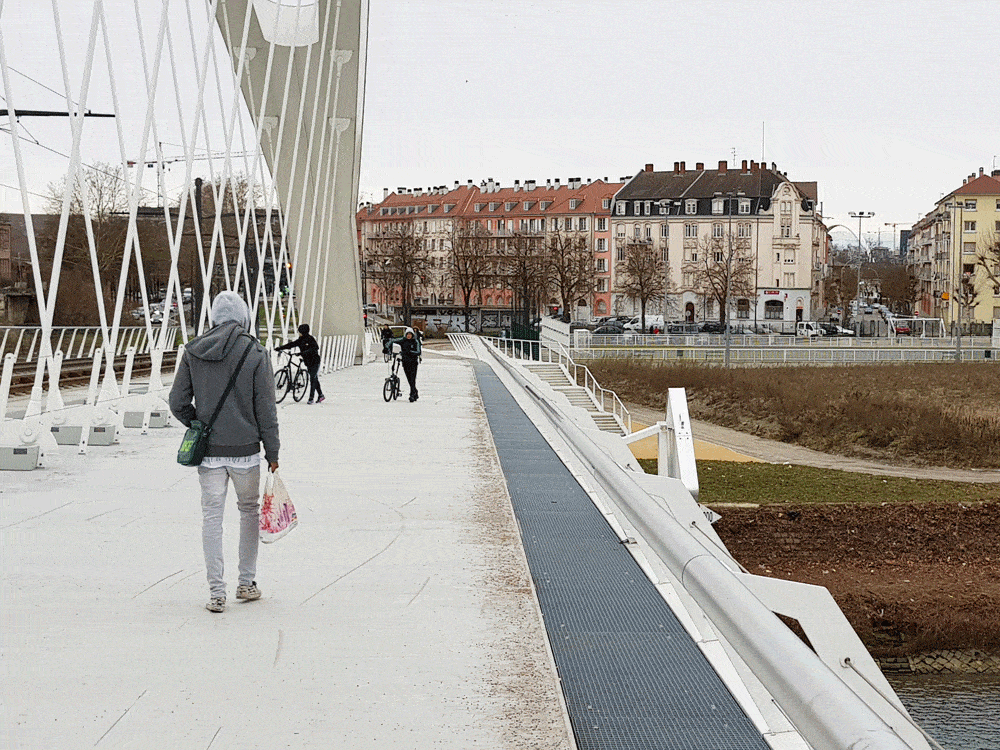
The roundtable discussion on the 3Land project, held the following morning, further illustrated this point. In addressing mobility and development challenges, the 3Land project – implemented “in complementarity” across the three countries – demonstrates that “there is no alternative but to work together.” “This project reflects a territorial reality: it is a shared living area where borders fade in the course of residents’ daily movements.” Against a backdrop of severe congestion, participants stressed the need to strengthen connections between both sides of the river and improve mobility. A number of infrastructure projects have therefore been developed to facilitate crossings of the Rhine while promoting sustainable modes of transport. Among them, the Nova project could lead to the construction of a new bridge linking Switzerland and France, complementing the existing pedestrian and cycling bridge between France and Germany.
A call from the network to rethink spatial planning
In closing the General Assembly, President Christian Dupessey reaffirmed the network’s ambition – and that of elected representatives from cross-border territories – to play an active role in both French and European discussions on spatial planning, ensuring that border-related issues are fully taken into account:
“We had high expectations for Dominique Faure’s report on spatial planning, but France is portrayed as if it were an island! Europe is mentioned only in the context of cohesion policy.”
“What about economic interdependencies and the need to complete the Single Market so that SMEs can grow across borders, as highlighted in Enrico Letta’s report? What about cross-border labour markets, with more than 500,000 cross-border workers along France’s borders? What about cross-border mobility? What about ecological continuity? And above all, what about citizens? How can we convince the one-third of French and European citizens who live near a border – many of whom choose to abstain from voting or support sovereigntist parties – that open borders are an opportunity?”
“Let us relaunch European spatial planning, starting from cross-border functional areas!”
Autres travaux de l’association [FR]
Les deux journées ont également été l’occasion d’adopter le rapport d’activité 2025, d’échanger sur le programme de travail 2026 et les priorités des adhérents. Autres temps forts :
- l’élection complémentaire du Bureau de la MOT (mandat 2024-2027)
- la présentation de l’avancement de BRIDGE-FR (mise en œuvre du règlement européen BridgeforEU aux frontières françaises, voir les présentations réservées aux membres sur la page de l’événement)
- la présentation des premiers résultats de l’étude flash sur les GECT (voir les présentations réservées aux membres sur la page de l’événement)