European study Resilient Borders – Cross-border Crisis Management and Spatial Planning: Policy publication and Compendium of pilot actions June 2026 The "Resilient Borders - Cross-border Spatial Planning and Crisis Management project", coordinated by the MOT and the Association of European Border Regions (AEBR) with the support of DG REGIO, supported nineteen pilot projects across thirteen European borders between 2024 and 2025. Its objective was to strengthen the resilience of border regions by improving cross-border cooperation in the fields of spatial planning and crisis management. The final publication brings together the lessons learnt from the pilot projects, identifies the main methodologies and best practices, and sets out recommendations for public decision-makers. It serves as a reference tool to foster more resilient cross-border cooperation and inspire new initiatives across Europe.
Position statement / Manifesto Manifesto for balanced economic development in cross-border territories April 2026
Partnership/national study Expérimentation “Bassins de vie transfrontaliers” : Connaitre, comprendre et agir à l’échelle des bassins de vie transfrontaliers [FR] May 2024 [In French only] Etude multipartenariale réalisée par la MOT avec le soutien de dix-sept partenaires. Entre 2023 et 2024, pendant plus d'un an, la MOT a mené une expérimentation sur les bassins de vie transfrontaliers sur cinq sites pilotes : l’Eurodistrict PAMINA (frontière franco-allemande), l’Eurométropole Lille-Kortrijk-Tournai (frontière franco-belge), le Nord Lorrain – Luxembourg (frontière franco-luxembourgeoise), Alpes du sud – Riviera (frontière franco-italo-monégasque), Agglomération franco-valdo-genevoise (frontière franco-suisse).
MOT Guides N°11 – The new challenges of cross-border mobility December 2022 Be it for freight or for passengers, for occasional or daily travel, mobility is at the heart of cross-border life. This 11th MOT thematic Guide gives an overview of the experiences and policies conducted in the field of cross-border mobility in various European territories. It highlights a wide variety of projects, but also obstacles, issues and major challenges for the years to come.
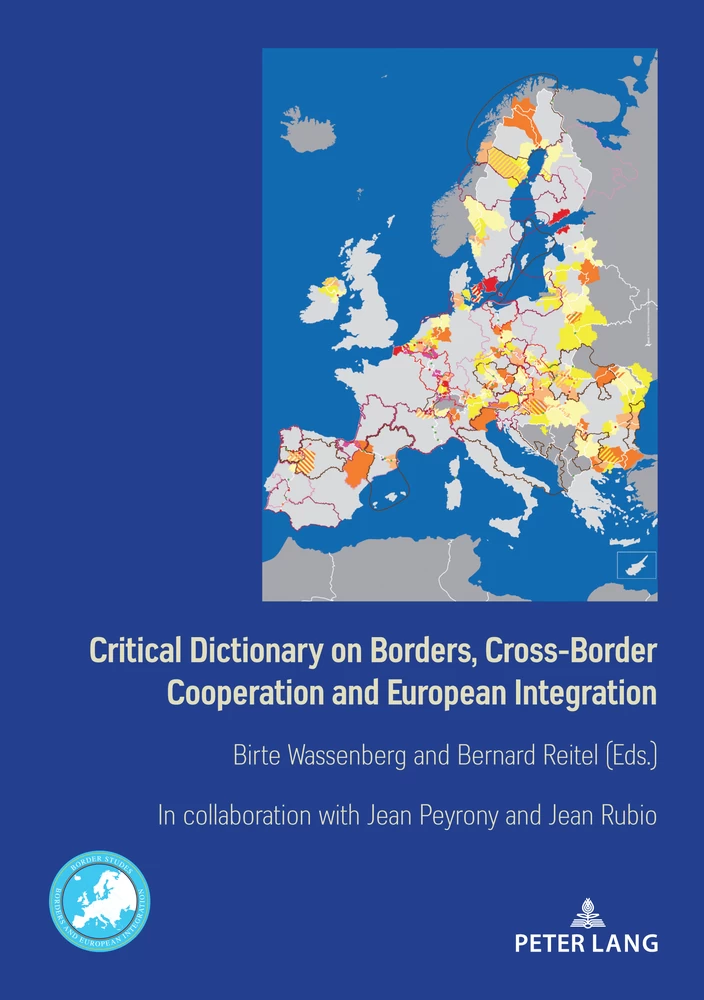
Scientific article / Dictionary Critical Dictionary on Borders, Cross-Border Cooperation and European Integration October 2020 Peter Lang, by Birte Wassenberg (Volume editor) Bernard Reitel (Volume editor) History & Political Science, Series: Border Studies, Volume 1. The "Critical Dictionary of Borders, Cross-Border Cooperation and European Integration" has just been published: a major publication that contains 209 articles written by 124 authors from different countries and academic disciplines, accompanied by 66 original maps produced by the MOT. Its aim is to answer the following questions: what is the role of borders in European integration? How does cross-border cooperation function concretely in the EU’s border regions? Does it contribute to European integration? Who are the players, and what are their motives, objectives and tools?
MOT Guides N°10 – The energy transition and cross-border cooperation January 2019 Neither the climate nor energy recognise national borders. Cross-border territories, as players in the energy transition, can take full advantage of the opportunities for development that it offers. The tenth edition of the MOT Guides highlights the stakes of energy transition in cross-border territories. What are the good practices? What kind of obstacles are there and how to overcome them? How do the different levels of energy policy fit together in France? What are the European Commission’s political and financial instruments in the area of the energy transition?
Brochure / Proceedings Cross-border territories: Europe’s laboratory January 2017 To mark its 20th anniversary, the MOT has published a brochure providing an opportunity to take stock of its work and look ahead to the future, and, more broadly, to assess the state of cross-border cooperation in Europe. The projects presented showcase the results of more than 20 years of cooperation. Twenty unique initiatives carried out by MOT members to benefit residents of cross-border regions are highlighted, along with other projects submitted by MOT members following the network’s call for proposals.
European study Cross-border economic development: Introduction to the topic September 2015 In the framework of a EU project, the MOT published two handbooks aimed at project developers and stakeholders involved in cross-border economic development. An Introduction to the topic (132 pages), accompanied by ten illustrative project factsheets, sets out the cross-cutting issues and analyses nine European borders. This document also contains recommendations that help players take greater advantage of the potential for the economic development of cross-border territories. Conducted in the framework of the Europ’Act technical assistance programme.
European study Methodological Guidebook : “Articulate cohesion policy, governance structures and cross-border territorial approaches” Conducted in the framework of the Europ’Act technical assistance programme, by the MOT and the DATAR. November 2012 This methodological guidebook published by the MOT with the DATAR in the framework of the project is intended to better articulate cohesion policy, governance structures and cross-border territorial approaches. Its 156 pages include a cross-cutting diagnosis of cooperation on each French border and 25 pages of recommendations.
MOT Guides N°2 – The law and practice of cross-border cooperation June 2002 How is a cross-border project - bringing together territorial authorities, their groupings and any other public or private entity from different countries - achieved? The MOT has been working since January 2000 toward the formation of a legal "toolbox" based on the field experience that it has described and analysed.